





“Browser OS” has always been, at least to me, shorthand for frustration wrapped up in a polished UI. ChromeOS gets away from that idea because it ships on dedicated hardware, but operating systems that run entirely inside browser tabs shouldn’t be tools you’d willingly rely on, right?
PuterOS wants to challenge that idea, and after spending a few hours with it, I’ll say this: it does a better job than it has any right to. It’s open source, free to boot, and much more usable than I’d expect from an operating system that runs entirely in a browser window. Here’s what it actually looks like.
Wait, this is a desktop in my browser tab?
Yes, it really is
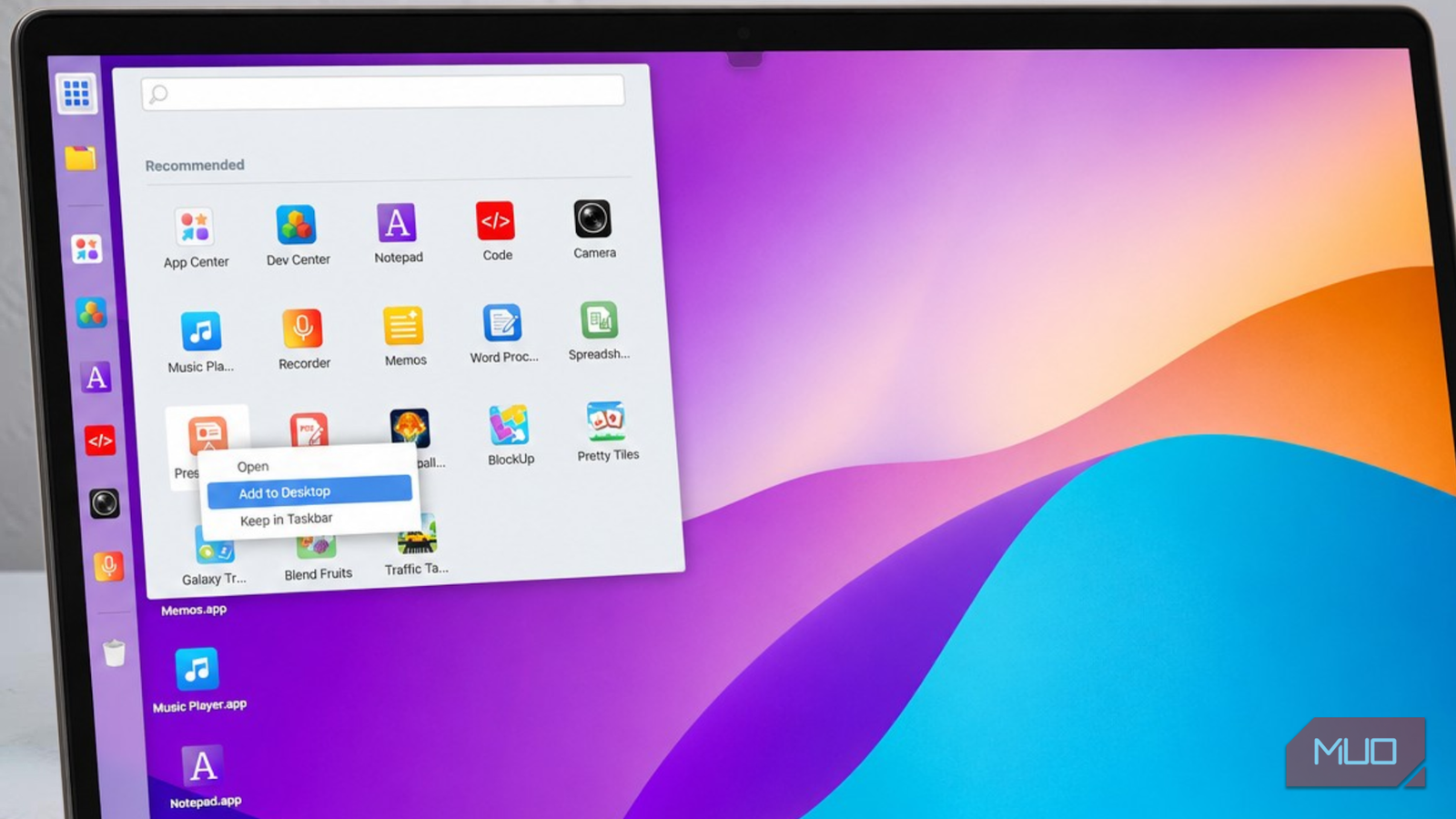
As I entered. puter.com In the address bar of my browser (and really, you can do this in any browser), I landed straight to a working desktop. I didn’t even need to create an account. You get a temporary guest session with a randomly generated username, a colorful gradient wallpaper, a taskbar on the left, and a desktop that you can populate with app shortcuts.
Now, before diving into the applications, I spent a lot of time exploring the dashboard, the nerve center of this “personal internet computer”. Going to the Files section reveals a full file manager with dedicated folders for Documents, Photos, Public, Videos and Desktop. I uploaded a folder containing nine .docx files totaling about 515KB, and the upload went through cleanly. A prompt appeared shortly after reminding me to save my session before these files disappeared. It takes you to create an account complete with a username, email, and password, followed by a six-digit email verification code. Quality stuff, beautifully handled.

Once verified, the usage panel immediately displays your free tier status, including 100 megabytes of cloud storage allocated. If you ever need more space for serious professional workloads, you can easily upgrade to the $10/month Basic plan for 100GB, the $25/month Professional tier for 500GB, or the $50/month Business plan with a massive 2TB capacity.
The Security tab is a dedicated session management panel that displays active logins on all devices. If you forget to sign out on a shared computer, such as a library machine or hotel workstation, clicking the red Cancel button quickly and securely deletes that specific alphanumeric session string.
Out of the box and already useful.
You get pre-installed apps that take care of your immediate needs.
Transitioning from the administrative dashboard to the desktop interface reveals a colorful, highly responsive visual workspace. Opening the main app drawer reveals a generous suite of pre-installed applications ready for immediate use without any additional downloads. These include an ONLYOFFICE-powered word processor, a spreadsheet, a presentation app, a PDF editor, a code editor, a camera, a recorder, and a music player. I opened one of my uploaded documents directly in a word processor, and it presented cleanly, retaining full formatting and with all the familiar menus.

I stopped using LibreOffice and switched to this open source office suite.
LibreOffice rocks, but there are things about it that don’t make it my solution.
I also found fully functional low pressure games like Galaxy Tropes, Basketball tape, Block up, Traffic tape puzzleand Beautiful tiles. Sitting right next to serious productivity tools. Naturally, I opened up Galaxy Tropes for “testing purposes”, and was more than impressed with how smoothly the arcade physics handled glowing projectiles and increasing numbered shapes. In fact, I briefly forgot it was happening inside what is essentially a website pretending to be a computer.
At some point, curiosity got the better of me, and I checked how much this whole experience was using up my actual computer. Running within Chrome, a single Pewter tab was using about 483MB of memory according to Chrome’s task manager. It’s not catastrophic, but it’s not trivial either. If your browser already looks like a graveyard of open tabs and half-completed tasks, you might notice extra weight and need to find ways to reduce Google Chrome’s memory usage and free up RAM.
If the built-in apps aren’t enough, there’s also a marketplace that dramatically expands the platform. It is highly organized, dividing software into clear categories including games, productivity, photo and video, developer tools, graphics and design, utilities, music and audio, business, entertainment, finance, education, and lifestyle. Browsing these sections gave me the impression that a veritable ecosystem is forming around this OS.
A browser that browses one place, and an AI that searches everything.
Not all tabs open where you expect.
One of the stranger parts of the experience was the built-in Putter browser. Every time I open it, I’m dropped directly to eBay’s home page, which for some reason seems to be the default landing page. The browser itself includes the usual navigation bar with bookmarks for YouTube and what’s called Pewter Networking, so at first glance it looks usable.
Then I tried to actually browse.
Attempts to open other sites, including MakeUseOf, were met with repeated “load error” messages with HTTP 301 redirects. Even clicking around within eBay produced the same result. I never wondered if the browser was partially broken, limited by design, or simply expecting some extra configuration step that I missed. Either way, I decided not to disappear down that particular rabbit hole for the rest of the day.
The most futuristic part of Pewter, though, is the AI assistant built right into the desktop sidebar. I started by asking what MakeUseOf was, mostly as a quick test, and it returned a fairly accurate summary focused on tech and productivity coverage. Assistant has two modes, Fast and Smart, which essentially trade speed for the depth you need.
What’s more interesting is how tightly the AI is integrated with the Pewter file system. I asked him to find the last document I worked on, and instead of giving a vague answer, he immediately offered to search my directories. It scanned my home folder and general locations, then came up with a single folder in my Documents directory with every Word file in it.
Remember, this was all happening inside a Chrome tab.
Close your apps, but only keep that tab
Puter won’t change your operating system, and to be fair, it’s not really trying. Technically, it still depends on the OS underneath it to function perfectly. But this almost misses the point. As a free, open-source computing environment that resides entirely in the cloud and runs from any browser without the need for installation, it should earn a permanent place in the bookmarks.
So, if you’re a developer looking for a lightweight platform to build or host apps, a student who occasionally needs a full-fledged document editor on a shared computer, or someone curious about where this whole web-as-an-operating-system idea is actually going, Puter is worth a look.